The Bayou Journal 🐊✨📰
Issue No. 7 | The History of Charity Hospital During Jim Crow

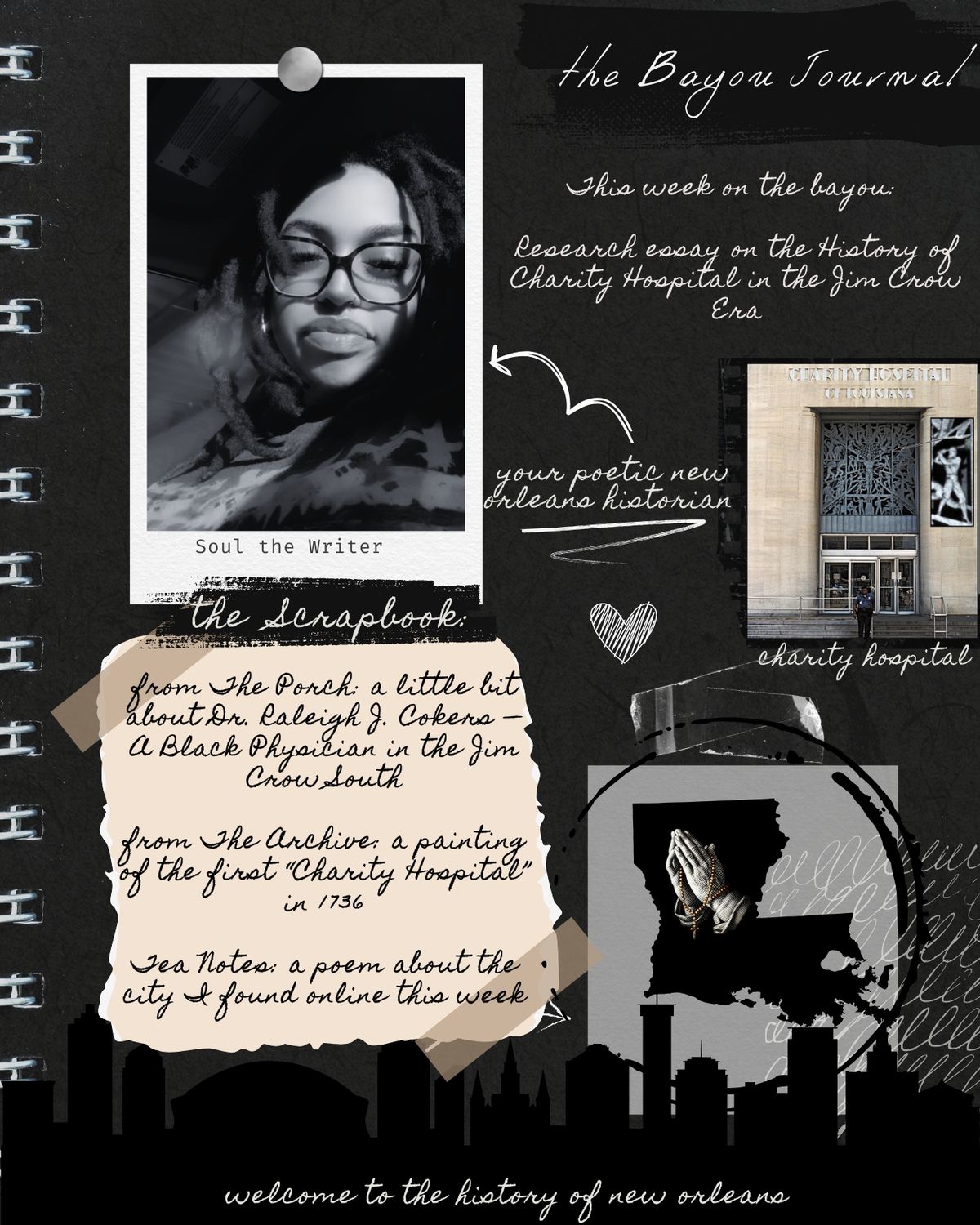
Good morning my history junkies!
I’m so glad to be back doing something that I absolutely love. When I’m not writing fiction, I’m practicing being a historian. If you know me, you know how much I love New Orleans — these Bayou Journals are so fun to work on.
This weekly (sometimes bi-weekly) journal surrounds the history of my favorite place on earth, New Orleans. You’ll find a quick history lesson, backstories on an important figure from New Orleans, and a poem that I found that surrounds the city that I love.
Today, we are diving into the history of Charity Hospital during the Jim Crow era — the first part of a three-week series. We will first be examining how the hospital functioned during Jim Crow and what segregation looked like within its walls. Next week, we’ll take a closer look at how Charity Hospital became the heartbeat of the city, including the work done by the Daughters of Charity. In week three, we’ll end the series by discussing the fall of Charity during Hurricane Katrina, sharing stories from the heroes who endured the horrific conditions inside the hospital during August and September of 2005 while doing everything they could to keep patients alive.
I hope you enjoy today’s issue!
📰 Research Essay: The History of Charity Hospital During the Jim Crow Era
For more than two centuries, Charity Hospital stood at the center of New Orleans’ public health system, serving as the city’s primary source of medical care the less fortunate. Established in 1736 through the estate of a French boat builder who was highly upset by the number of indigent people left without treatment, Charity was founded on the idea that the poor deserved care. Yet from its earliest years, that care was shaped by race, class, and even power.
In its early decades, Charity primarily served white residents and newly arrived European immigrants, particularly those from Ireland and Germany. Many arrived in New Orleans weakened by their long journeys across the Atlantic and unfamiliar diseases, and Charity became a place where they could receive treatment when private care was out of reach. Enslaved Black people, however, were not brought to Charity for medical care before the Civil War. Instead, they were treated — or neglected (more-so neglected) — on the plantations where they lived with their health considered the responsibility of the owners of the plantations.
This began to change after the Civil War. With the abolition of slavery and the slow restructuring of Southern society, Black patients were increasingly brought to Charity Hospital for treatment. But access did not mean equality. As Reconstruction faded and Jim Crow laws hardened across the South, segregation became embedded in the hospital’s daily operations, shaping everything from the entrances to patient wards.
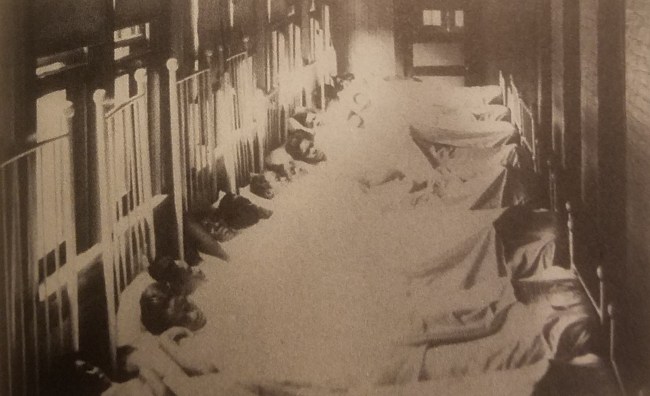
By the late nineteenth and early twentieth centuries, segregation at Charity was no longer informal or implied… it was the policy. Black patients were routinely directed away from the hospital’s front entrance on Tulane Avenue and instructed to enter through side or rear doors. In April of 1926, this practice was made set in stone when a sign was placed at the hospital prohibiting Black people from using the front entrance altogether. The message was unmistakable: Black patients could receive care, but only in ways that reinforced racial hierarchy and exclusion.
Inside the hospital, the unfair separation continued. Black patients were often placed in overcrowded wards with little privacy with rows of beds packed closely together in large open rooms. Comfort and dignity were not priorities for the Black community. Even essential medical resources reflected racial division. The hospital’s blood supply was categorized by race, labeled according to whether it came from white or Black donors — a knife-in-the-chest example of how deeply segregation penetrated the medical practice, extending even into life-saving procedures. WILD and sad, but not surprising.
Black medical staff faced their own barriers and issues, too. Black nurses were frequently denied the same training opportunities as white nurses and were limited in their ability to advance within the profession and seek higher opportunities. Many were forced to seek education and certification outside Louisiana if they wished to continue their careers. Despite these obstacles, Black nurses and caregivers formed the backbone of daily care within segregated wards, working long hours in an institution that depended on their labor while restricting their professional rights.
The hospital’s discriminatory policies did not go unchallenged in the slightest. In response to the 1926 entrance restriction, more than 300 Black citizens gathered at the Pythian Temple in New Orleans to protest the treatment of Black patients and demand dignity in public medical care (IKTR!!!!!!). Community leaders, physicians, ministers, and activists petitioned hospital administrators and city officials, arguing that charity could not exist alongside exclusion. These bold and courageous acts of resistance highlighted the growing insistence that public institutions funded by taxpayers should serve all citizens fairly — a demand that would echo loud and proud throughout the Civil Rights Movement.
Despite its unequal practices, Charity Hospital remained a vital institution for generations of New Orleanians. Tens of thousands were treated there, many with no other options available. Over time, the hospital became woven and stitched into the city’s soul and memory, producing generations of “Charity babies” who were born within its walls. Fun fact, Lil Wayne was born at Charity Hospital and so was my husband!
However, even with Charity becoming the heartbeat of New Orleans at some point, it does not erase the harsh realities of it’s early days. During the Jim Crow era, care at Charity was offered conditionally, shaped by a system that prioritized whiteness and enforced separation even in moments of illness and vulnerability. Charity Hospital survived wars, fires, political upheaval, economic strain, and integration before finally closing after Hurricane Katrina in 2005. Its long history reflects the sad but true contradictions of New Orleans itself — resilience alongside inequality and care alongside exclusion.
Source:
“Charity Hospital During the Jim Crow Era,” CreoleGen.org (2019)
From the Porch: Dr. Raleigh J. Coker — A Black Physician During the Jim Crow Era in the South
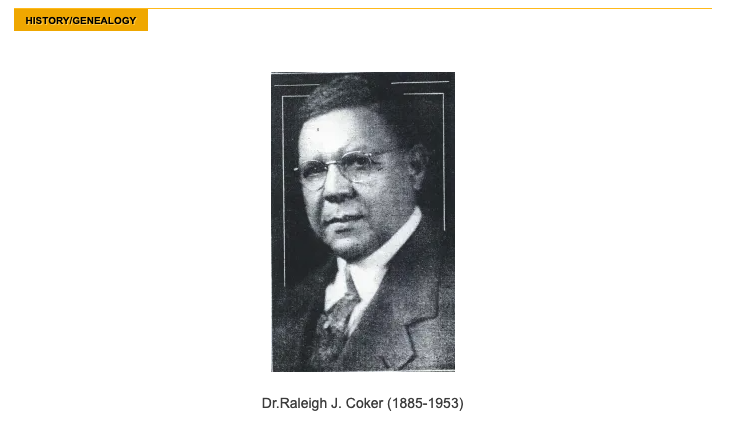
Raleigh J. Coker was born in New Orleans around 1885, into a world that didn’t exactly make room for Black professionals — especially not Black physicians. Still, he became one. He grew up here, attended public schools, took courses at institutions like Southern and Walden Universities, and went on to graduate from Meharry Medical College in 1909, one of the few medical schools in the country open to Black students at the time.
He returned to New Orleans to practice medicine in the Jim Crow South, where segregation shaped every aspect of daily life, including healthcare. For Black physicians, medicine wasn’t just about treating illness, but was about access as well. Who could be seen, where they could be treated, and under what conditions were questions decided long before a patient ever stepped into a room.
Black doctors like Coker worked within systems that routinely treated Black patients as secondary. Hospitals were segregated, facilities unequal, and professional opportunities limited. Even within Black communities, physicians often faced additional challenges. Many Black families preferred white doctors because segregation had conditioned people to believe white institutions offered better care. Which, if I’m being honest, some people are still in some way conditioned this way even today, in 2026. White doctors, meanwhile, were often willing to treat Black patients as long as they could pay.
So Black physicians had to do more than practice medicine, they had to create space for it.
Dr. Coker did that work through community-based healthcare. During the 1920s, he served as medical director of health clinics operated through the Unity Industrial Life Insurance Company. These clinics functioned as weekly community spaces, offering medical examinations, vaccinations, and education — especially for expectant mothers and children. While tied to insurance policies, they provided consistent access to care in neighborhoods that were otherwise underserved.
He worked closely with registered nurse Alice V. Bachemin, a longtime collaborator who remained at his side for years. Together, they navigated a system that relied on their labor while offering little institutional protection or recognition in return.
Dr. Coker also served as medical examiner for other Black-led insurance organizations, including National Industrial and Supreme Life Insurance companies, extending his reach across New Orleans’ Black communities through the 1920s and 1940s. His work connected medicine, employment, and community survival in ways that were practical, strategic, and deeply necessary.
With the opening of Flint-Goodridge Hospital in 1932 — one of the first hospitals in the city where Black physicians could fully practice — doctors like Coker gained greater autonomy. There, he participated in obstetrics and well-baby clinics, helping address high infant mortality rates at a time when Black families were often denied consistent prenatal and postnatal care.
What stands out about Dr. Coker is not that he worked within a broken system, but that he worked around that very broken system. His career was built through trust, community presence, and persistence rather than institutional endorsements. Clinics, examinations, and preventative care were acts of insistence. Insistence that Black bodies mattered and that access to care should not depend on proximity to whiteness.
Very little about Dr. Coker survives in mainstream historical records. There is no polished biography or anything really pertaining to him online. That absence is not accidental at all, let me tell you. It reflects a wider pattern in which Black professionals were allowed to work and serve, but rarely were they preserved. HELLO SOMEBODY!!!!
Their labor was relied upon, but unfortunately, their stories were not protected.
When we talk about Charity Hospital, segregation, and unequal access to care, figures like Dr. Coker matter as working professionals navigating impossible conditions.
Source:
CreoleGen.org — “A Black Physician in the Jim Crow South: Dr. Raleigh J. Coker (1885–1953)”
From the Archive: Charity Hopsital During Jim Crow Era
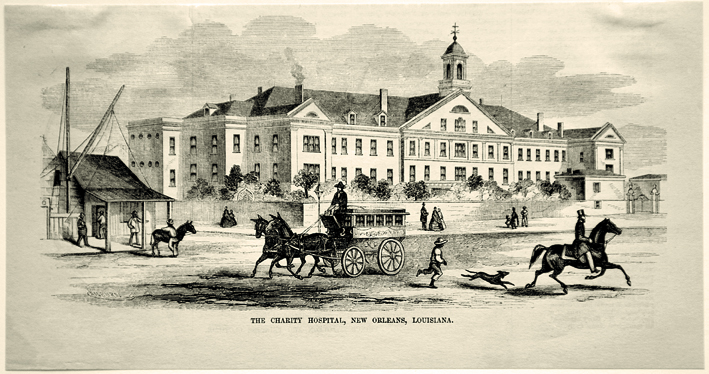
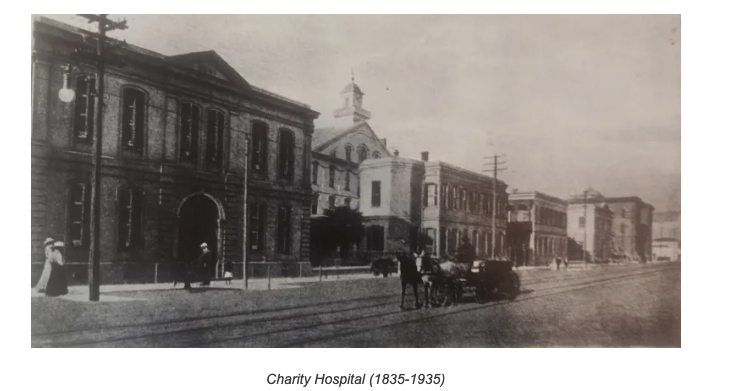
While searching for an image of Charity Hospital in its earliest days, I thought I had found a painting of the hospital online. It turned out to be a depiction of a French colonial settlement in New Orleans during the 1700s. No known image of Charity’s original structure can be found, sadly, but I was able to find what the hospital looked like during the Jim Crow era — before the modern mid-20th-century building most people recognize today.
Tea Notes: New Orleans Girl Poem
As we wind down this issue of the Bayou Journal, I wanted to leave you all with a poem I found this week.
New Orleans Girl - Poem
by Dat Nola Chic. I will link it here and the contents of the poem are below!
In the city of New Orleans, a black girl grows,
With a heart full of dreams, and a spirit that glows.
The streets are tough, and the nights are long,
But she finds solace, in the music and song.
From the jazz on the streets, to the gumbo to the crawfish boils,
Her culture is alive, in the midst of the storm.
And though she faces struggle, and hardship so deep,
Her spirit never wavers, and she never loses sleep.
At a young age, she became a mother too soon,
But her love for her child, kept her going through.
She embraced her roots, held them tight in her heart,
And through her struggles, her culture became a work of art.
She learned to cook, to dance, to sing,
And her culture became a salve for everything.
With every step she took, her spirit lifted high,
And she knew her culture was the answer, as to why.
As she grew older, with her child by her side,
She overcame poverty, with her culture as her guide.
Though her struggles remained, her love never fell apart. As The city gifted her opportunities for a renewed start.
And when she looked back, at the journey she’s been through,
She realized her culture, was the reason she made it through.
New Orleans culture became her lifeline, her guiding light,
In the midst of the chaos, she found the strength to fight.
And as time passed, and she grew older and wiser,
She remained proud of her roots, and a true New Orleans survivor.
Thank you so much for taking the time to read this week’s issue. It took a lot of time, but it was worth every second! I will see you all back next week! Until then, much love — from my little corner of Louisiana. <3