The Bayou Journal: Issue 6✨
Sickness and Resilience in the city of New Orleans

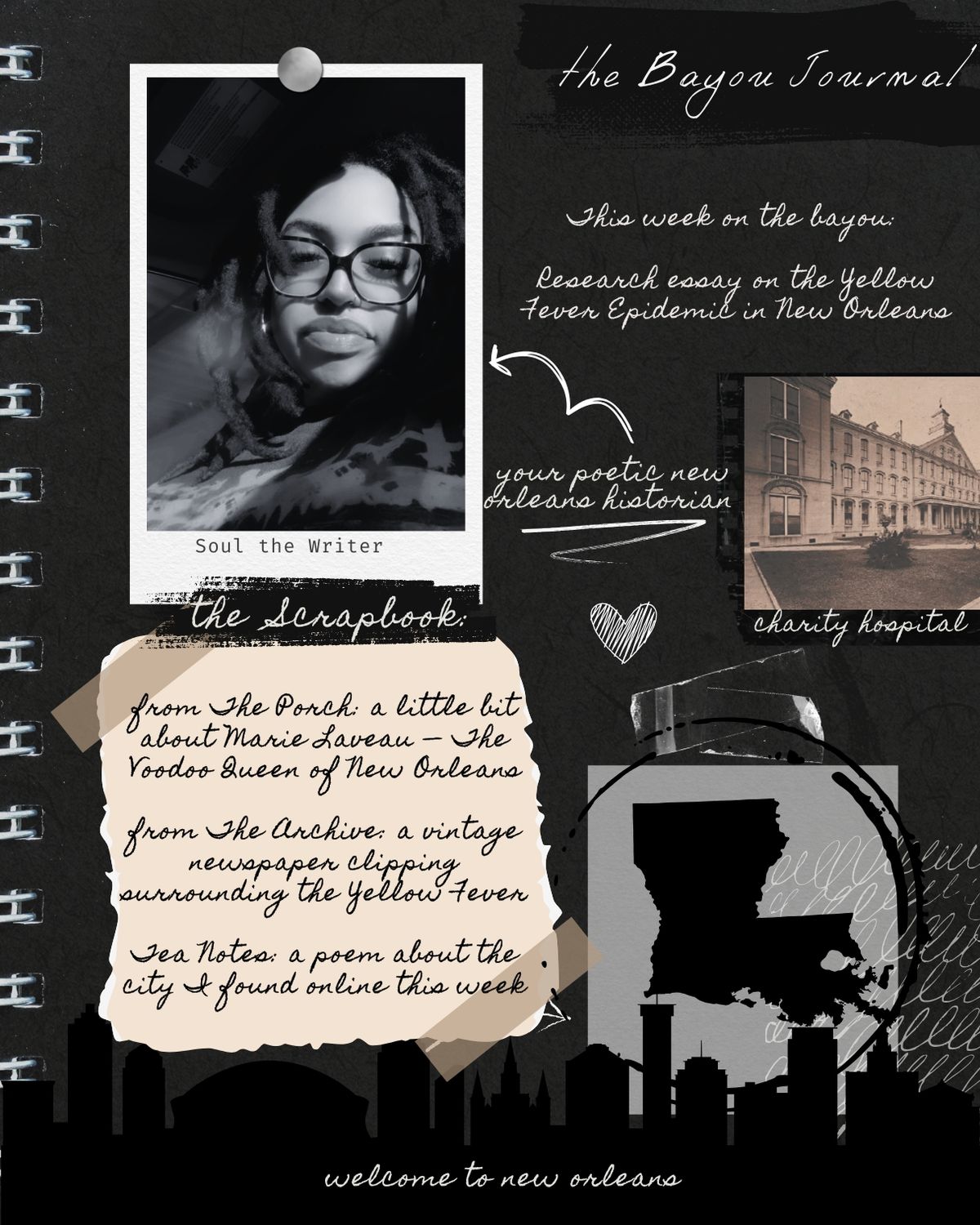
Good morning my little history junkies! Welcome to another Bayou Journal Issue — curated only for my paid subscribers! This was supposed to come out this previous Friday, however I was sick and not really feeling well.
This weekly (sometimes bi-weekly) journal surrounds the history of my favorite place on earth, New Orleans. You’ll find a quick history lesson, backstories on an important figure from New Orleans, and a poem that I found that surrounds the city that I love.
Every week it’s something new! I hope you enjoy. :)
📰 Research Essay: The Yellow Fever Seasons of New Orleans
The first big outbreak of the Yellow Fever hit in 1796, and it knocked the city completely off its balance — over six hundred people died in a place that barely had nine thousand residents at the time. Oh, but it didn’t stop there. By the summer of 1853, Yellow Fever had become a full-blown nightmare. Almost thirty thousand cases and nearly nine thousand deaths. Entire neighborhoods fell quiet and families were shook. The hard part is… they didn’t understand what was causing it. Folks blamed the river air, the heat, the smell of the port — anything they could think of. People burned tar in the streets and lit bonfires, hoping the smoke would “chase away” the sickness. Doctors walked around with herbs stuffed in their pockets and everybody was guessing what this sickness could be, but they thought wrong.
Yellow Fever had a weird pattern though, it would hit newcomers the hardest. Immigrants, new workers, people who’d just arrived looking for a fresh start… they were the most vulnerable. Locals who had survived a previous wave often made it through another. It created this strange divide almost; between those who had lived through it and those who hadn’t yet been tested for it.
Although the city was in fear and concerned, the community came together big time. Communities stepped in where medicine fell short. Women, especially women of color and the Sisters of Charity, became caretakers when nobody else wanted to enter the sickrooms. Orphanages continued to fill, neighbors helped neighbors, and the city kept trying to hold itself together in whatever ways it could.
The last major epidemic came in 1905, and by then the truth finally came out: it wasn’t the river or the air… it was mosquitoes. Once people understood that, the city changed how it lived. Draining water and cleaning up the places where the insects bred. Bit by bit, the fever loosened its grip.
When you walk through New Orleans today — especially in the summer — it’s wild to think about how much this city endured in those long, heavy months. The balconies, the courtyards, the brick walls built thicker than they needed to be… they’re all part of a city that learned to survive loss and keep going anyway. One thing we’ve learned throughout these Journals is that New Orleans is a resilient soul. The city continues to bounce back no matter what is thrown its way.
New Orleans has always been a place that knows how to rebuild, how to mourn and still show up the next day. Yellow Fever is one of those chapters that shaped the city deeply and reminds us of just another thing that New Orleans has had claw and find its way to come back from.
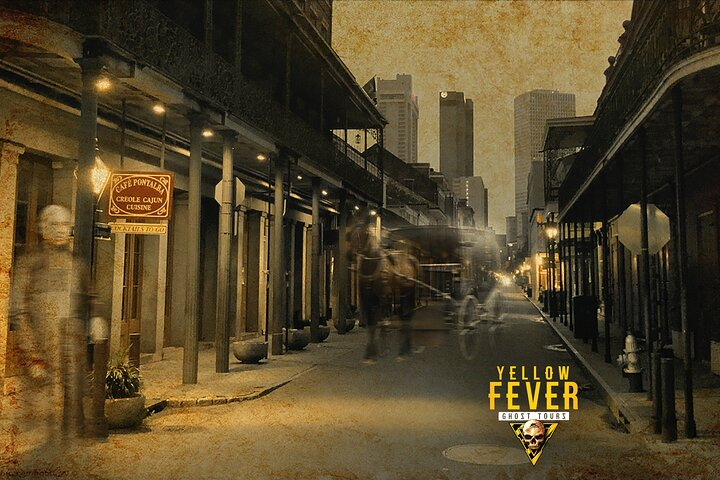
Fun Fact: One of the stops on the Yellow Fever Ghost Tour is the New Orleans Pharmacy Museum (514 Chartres St). Back in the 1800s, during the yellow fever epidemics, this building was once a real pharmacy where folks brought their fears and their home-remedies. You can book a Yellow Fever Ghost tour and learn more the next time you’re in New Orleans!
🏠 From the Porch: Marie Laveau — the Voodoo Queen of New Orleans
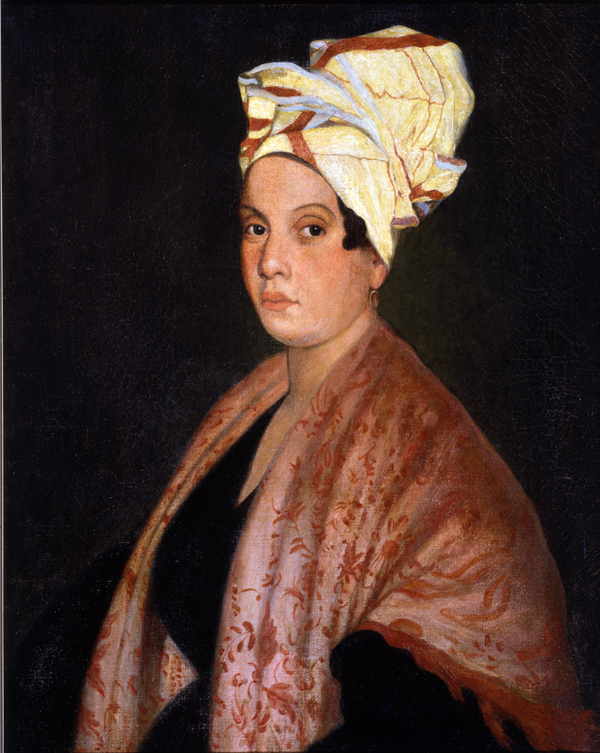
There are women who walk into a city and leave it changed by the weight of their presence. Marie Laveau was one of them.
Born in the Quarter in 1801, her roots ran through Africa, Europe, and the native lands— woven into the very soil of New Orleans. She bore a lineage of survival and of freedom and that very inheritance became her superpower.
At a time when even her freedom was a gift, Marie chose to serve. She held ceremonies and consultations, yes—but she also healed. She comforted the poor, the sick, and the prisoners on their last nights. She showed up even when the walls of society expected her to stand down.
She worked inside two worlds — the church and the ritual path. Catholic Mass, séances, herbal remedies, prayers behind iron gates, altars in hidden corners of the Quarter. She understood that spirituality was a collection of small acts; a promise made again and again… like a door held open even when the nights get long and the city is full of ghosts.
She believed in community and power shared and in healing that didn’t need a name or a certain face — just the need to be healed. Because of that, when she died in 1881… New Orleans wept. No matter the class or the color, people mourned. Because she’d shown them one thing: you are matter and you belong.
If you ever stand in Jackson Square and feel the breeze off the river or hear the faint drums echoing from the alleys— listen; just listen. That might just be Marie’s voice, laughing in the shadows and reminding the city both of its magic and its mercy.
📠 From the Archive
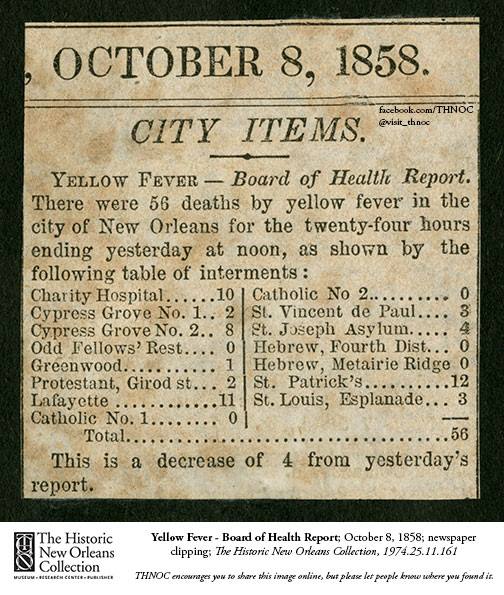
This image is an old health report surrounding the yellow fever during the 1800s. I love being able to find old archives like this regarding the city. It may not be much, but it lived. It holds a place in history in the city that I love.
🫖 Tea Notes
To end this week’s Journal, I have found yet another poem for you to read. I’m not gonna lie, its so hard sometimes to find a good poem written about New Orleans. Not because they aren’t good, but because I have to search high and low for them, LOL. Which is fine, but I might need to go to the library and see if I can find a poetry book that has nothing but New Orleans poetry in it. Goddamn it, if I have to, I’ll make my own! But anyway — here is a poem by Jeffrey Pipes Guice called It’s All About Fun. I thought it was short, sweet and cute — something light after learning about fevers and sickness, LOL. But it’s how I feel also anytime I visit New Orleans — I don’t feel rushed, I don’t feel any negative energy, I feel at peace. Nothing but fun and good vibes when I visit the city <3.
It’s All About Fun
Is this a race
Who’s in the lead
When you’re in New Orleans
It’s not about speed
Don’t worry about work
It’ll all get done
When you’re in New Orleans
It’s all about fun
Don’t worry about whether
You’re comin’ or goin’
When you’re in New Orleans
There’s no way of knowin’
So, grab yourself a cold drink
The good times have begun
When you’re in New Orleans
It’s all about fun
That’s it for this week’s Bayou Journal. I hope you guys enjoy these little slices of history every week. Shout out to my mom who reads them faithfully. She loves New Orleans just as much as me if not more and she said that she’s been learning a lot. These started because I wanted to give her something special every week to read about the city she and I both adore down to our knees. See yall this upcoming Friday!